
Global mobility software for HR and mobility teams
Workia is global mobility software for teams who manage employee moves without a large back office. Cases, checklists, approvals, cost estimates, documents and reporting in one place — no implementation project, no spreadsheet sprawl.
What global mobility software does
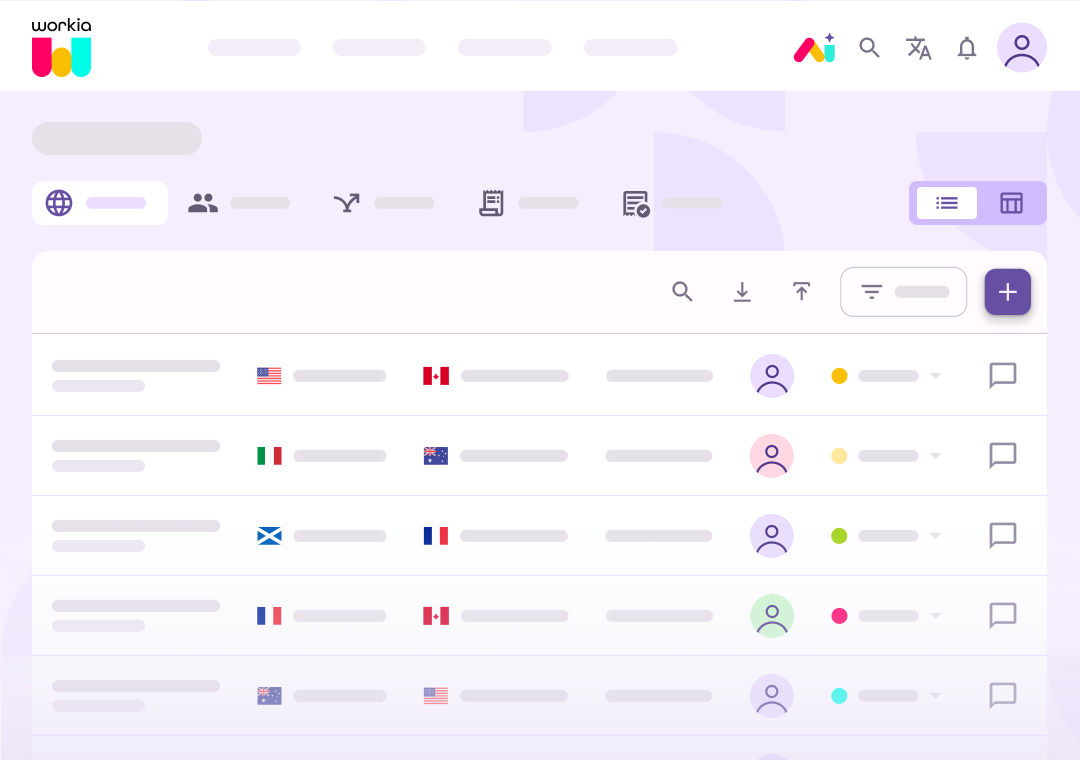
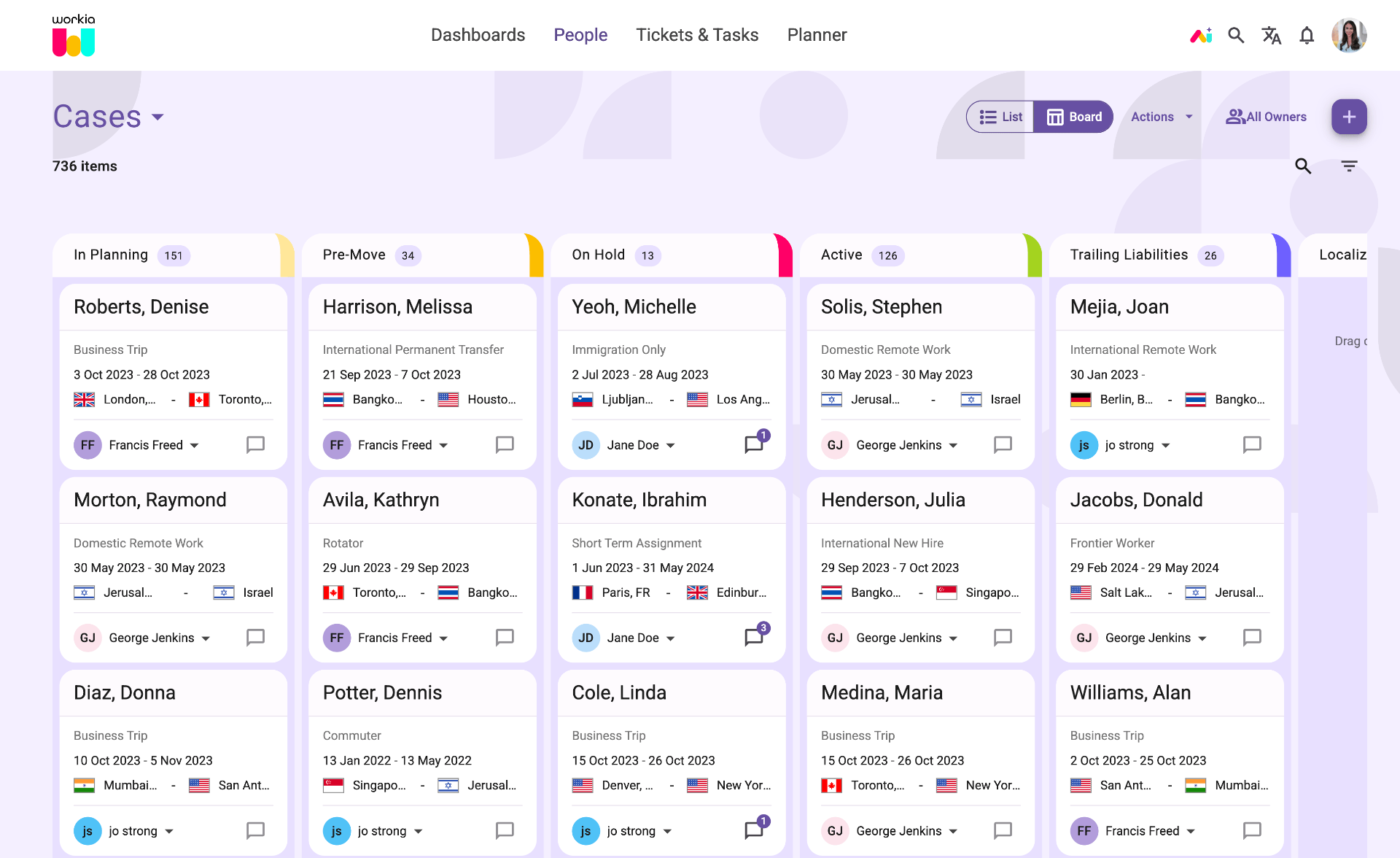
One case per move
Every relocation, assignment or transfer gets a single structured record — dates, family, locations, documents and history in one place instead of a tab per person.
Checklists per move type
Standardise the process for each move type so the same steps happen every time, with owners and due dates the whole team can see.
Cost estimates before you commit
Model the cost of a move up front — allowances, tax, relocation and vendor costs — so the business can approve on numbers rather than guesswork.
Compensation packages and pay splits
Build policy-aligned packages and allowances, split pay across multiple payrolls, and export the figures as Excel, PDF or tax report formats for payroll to action.
Documents and letters
Generate assignment letters, cost summaries and relocation paperwork from templates, sign them and keep them attached to the case.
Alerts before deadlines
Get warned about visa expiries, assignment end dates, day-count thresholds and overdue tasks before they turn into a compliance problem.
Reporting on the whole programme
Answer who is where, on what terms, at what cost — without a manual data pull the night before the meeting.
Connected to your stack
Sync with HRIS, payroll, email, document signing and your supplier network so the same data is not typed in twice.
Spreadsheets or mobility software
Most of this can be done in a spreadsheet — that is why so many teams still do it. The difference is how much manual work it takes to keep accurate, and how much risk sits in files full of pay, passport and family data.
| The job | In spreadsheets | In Workia |
|---|---|---|
| Tracking a move end to end | Possible, but each move lives across tabs, emails and folders, and someone has to keep them all in step. | One structured record per move, updated as the move progresses. |
| Checklists and next steps | Built and maintained by hand for every move type. | Checklists by move type out of the box, configurable to your process. |
| Cost estimates and compensation calculations | Doable in formulas, but versions drift and a broken cell is easy to miss. | Structured calculations with assumptions, versions and exports kept together. |
| Approvals and audit trail | Approval usually sits in an email thread, so evidence is scattered. | Approvals captured against the move with a dated history. |
| Deadlines and expiries | Relies on someone remembering to check the sheet. | Alerts on key dates so nothing quietly lapses. |
| Reporting | Achievable with pivot tables, once the data has been cleaned up. | Programme-level reporting on the data you already captured. |
| Sharing with vendors and employees | Files get emailed around, which is where most of the data risk sits. | Controlled access per person, so people see only what they should. |
| Security and personal data | Sensitive pay, passport and family data in files anyone with the link can copy. | Permissioned, hosted and access-controlled by design. |
Lean teams, real programmes.
Workia is built for the mobility manager who owns the programme alongside a day job, and for HR teams who inherited mobility without inheriting a system to run it in.
Explore solutionsGlobal mobility software questions
Still deciding whether you need it? Read the primer on mobility technology.
What is global mobility software?
Global mobility software is a system of record for employee moves. It holds a case for every relocation, assignment or business trip, and manages the process around it — checklists, approvals, cost estimates, compensation, documents, vendor instructions and reporting — so mobility and HR teams are not running the programme from spreadsheets and email.
How is it different from an HRIS like Workday, SAP SuccessFactors or Oracle?
The HRIS stays the single source of truth for employee information. It holds the employee record: job, pay, org structure. It does not manage the move itself — the case, the checklist, the cost estimate, the visa dates, the vendor instructions. Global mobility software handles that process and pulls in key employee information from the HRIS, so records stay up to date and nobody has to enter the same details twice. That is why Workia integrates with Workday, SAP SuccessFactors and Oracle rather than replacing them.
Do we need global mobility software if we only move a handful of people a year?
Volume matters less than complexity and risk. A programme of 15 moves a year across five countries carries the same immigration, tax and duty-of-care exposure per move as a programme of 500. The question to ask is whether you can answer, today, who is where, on what terms, at what cost, and what is due next.
How long does implementation take?
Workia is designed to be used without an implementation project. There is no lengthy configuration phase or systems integrator — you can start with your existing move types and data, and connect integrations later.
Can it handle both international and domestic moves?
Yes. Workia covers one-way relocations, long and short-term assignments, rotational moves, commuters, remote work arrangements and domestic moves, each with its own checklist.
Ready to make global mobility easier?
See Workia in action. Book a guided walkthrough or jump straight into a self-serve product tour.